
Designing Online Courses That Work for Students
I teach fully online, asynchronous Information Technology courses at Broward College Online. This page documents how I design, deliver, and manage those courses, aligned to the Teaching criteria of the Broward College faculty evaluation: Content Knowledge, Instructional Delivery, and Instructional Management.
Overview
Online Course Design as Teaching Practice
In a fully asynchronous course, the course itself does much of the teaching. Students meet the material on their own schedules, so the structure, clarity, and alignment of the course shell determine whether they can succeed. For that reason, my teaching practice centers on intentional online course design: clear expectations, materials aligned to the course learning outcomes and to industry certification objectives, and a predictable path through each module.
That focus led me to complete Harvard Extension School’s Graduate Certificate in Learning Design and Technology, building on my ACUE Certificate in Effective College Instruction. I apply that preparation directly in the courses I develop and teach, from CompTIA certification courses to ISM 3309C, Agile Product Ownership, which I designed from the ground up.
My approach ensures students don’t just memorize content for certification exams but develop the analytical and practical skills necessary for successful IT careers.
Ricardo S. Vargas, MS
Course Design
Course Design: ISM 3309C
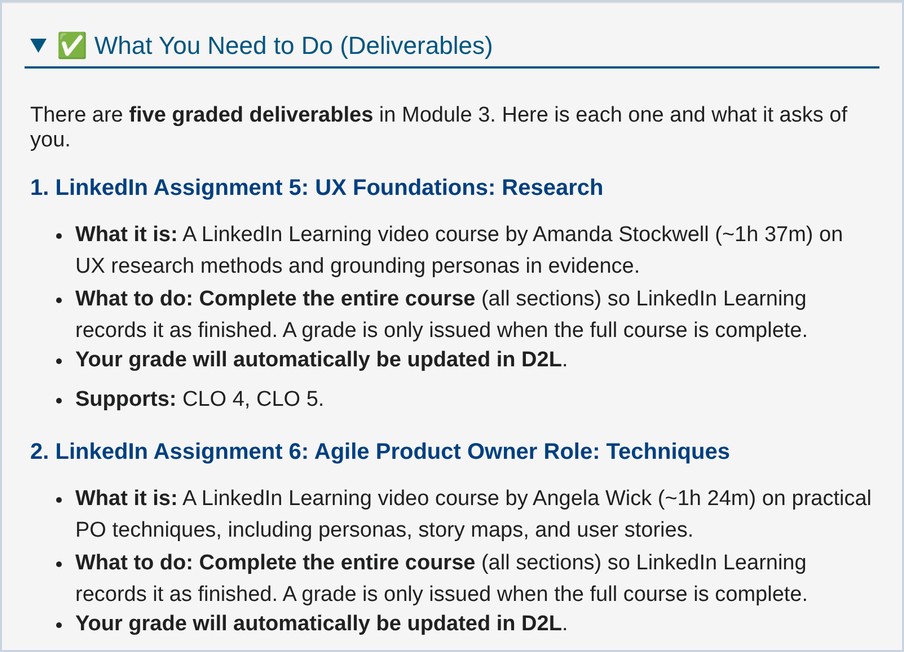
ISM 3309C, Agile Product Ownership, was my first full course development after completing the Harvard certificate. I built the baseline D2L course shell from scratch as eight modules organized around a single design idea: students learn each Product Owner technique on a low-stakes practice product, then apply the same technique to their own product, building toward a Final Project Portfolio that integrates all five course learning outcomes. My design decisions supported:
- Alignment traceable end to end — the official course outcomes appear on every module and activity page, and a Course Learning Outcomes Map shows coverage across all assessment types.
- Formative-to-summative scaffolding — Application Exercises with analytic rubrics, mastery-graded Project Milestones with a resubmission cycle, and a Final Project rubric that rewards integration and revision.
- A consistent page design — a professional, repeatable module template that lowers cognitive load and makes the course easy to navigate.
- Complete instructor support — a Quick Start Guide with term checklists, suggested schedules for 6- to 16-week terms, and a textbook reference, so any section instructor can teach the course as designed.
The course was reviewed through Broward College’s e-learning course design process. On the BC Faculty Reviewer Form (September 2026), it met all five General Standards reviewed (GS1–GS5) and was recommended for delivery. On the BC Quality Standards for E-Learning Course Design Sign-Off Form, which integrates Broward College standards with the Quality Matters Higher Education Rubric (7th edition), the Senior Instructional Designer and the Faculty Reviewer confirmed the applicable standards across all eight General Standards, including Course Technology, Learner Support, and Accessibility and Usability. The review described the course as an exceptionally well-designed asynchronous course and a model course.
I treated the review as a chance to make a strong course better. Within two days of receiving the reviewer’s suggestions, I submitted a written feedback utilization to the Senior Instructional Designer documenting what I changed and what I planned: I aligned the syllabus and course calendar with revised extra credit opportunities, added a submission checklist to each project milestone, corrected the instructional materials for Application Exercise 3, and planned new sample announcements for the baseline shell before the next offering.
Evidence
- ISM 3309C baseline course shell: Module 3 overview (outcomes, readings, and deliverables) (ETP1)
- BC Faculty Reviewer Form, ISM 3309C (September 2026): all five General Standards met; recommended for delivery (ETP2)
- BC Quality Standards for E-Learning Course Design Sign-Off Form, ISM 3309C: signed by the Faculty Reviewer and Senior Instructional Designer (Associate Dean and Dean signatures pending) (ETP3)
- Feedback utilization, ISM 3309C (October 2026): changes made in response to the course design review (ETP11)
Content Knowledge
Content Knowledge and Depth
I primarily teach Microsoft Office and CompTIA A+, Network+, Security+, and Linux+ courses. Drawing on my own training, certifications, and industry experience, I select course materials aligned to certification objectives and update courses as those objectives change.
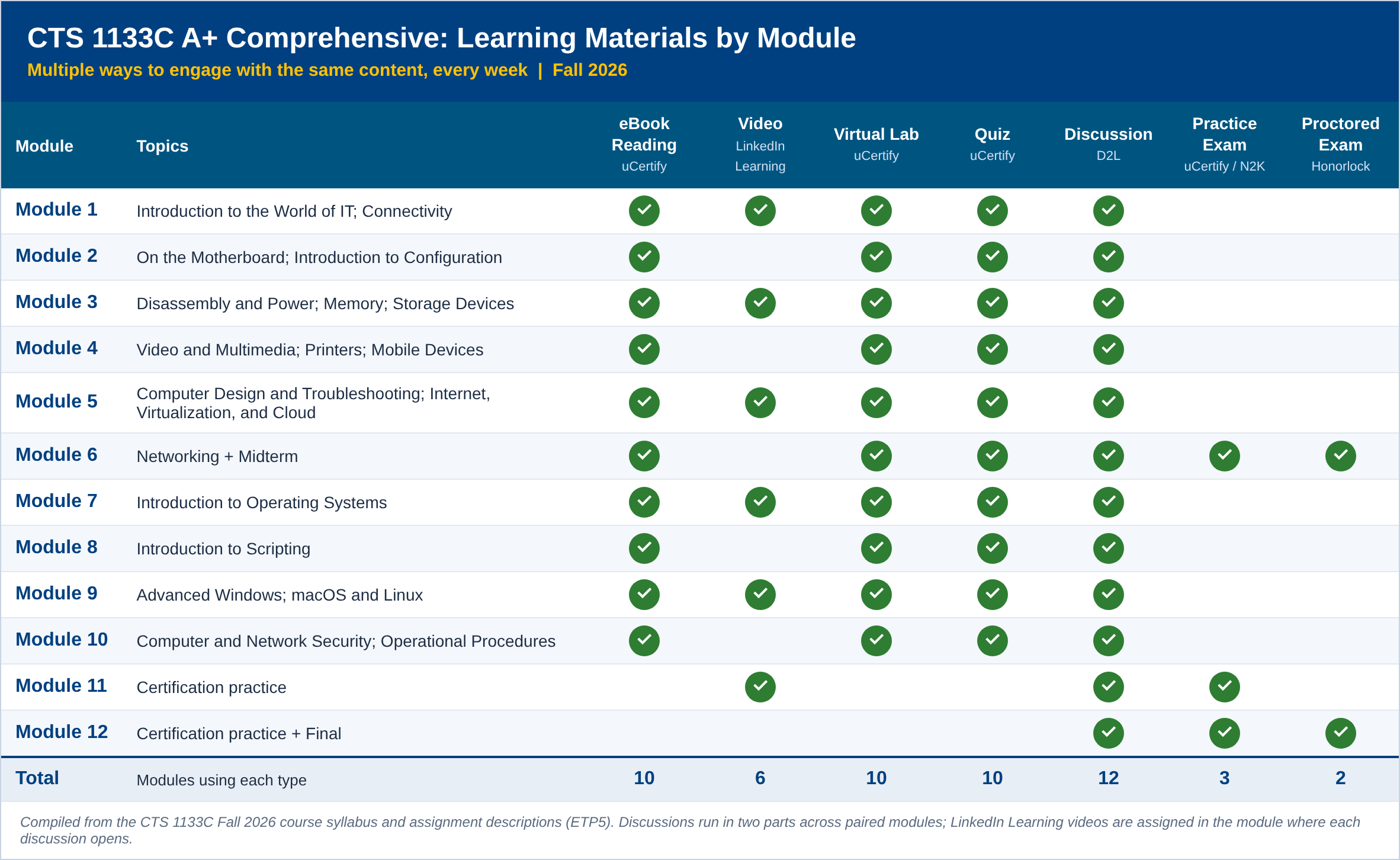
Each course pairs an e-text with instructional videos, virtual labs, and certification-style practice exams, giving students multiple ways to engage with the same content: reading, watching, and practicing hands-on. This approach reflects the Universal Design for Learning principle of providing multiple means of representation, so students with different backgrounds, preferences, and needs can each find an effective path to mastery. Since becoming a full-time faculty member, I have developed or redeveloped online courses including CTS 1111C, CTS 1133C, CTS 1134C, CTS 2120C, and ISM 3309C.
Evidence
Instructional Management
Syllabus, Materials, and Alignment
The syllabus is available when the course opens and is reviewed with students during the first week. Course materials are mapped to the learning outcomes they develop: e-book chapters and quizzes build core concepts, labs and certification practice exams build hands-on skills, and LinkedIn Learning videos and discussions support higher-order outcomes such as analysis and evaluation.
Evidence
Employer Needs
Responding to Employer Needs
Employers consistently report that they seek candidates who hold industry certifications and current knowledge in the field. In response, since becoming a full-time faculty member I have redesigned the following certification courses so that students learn current, exam-aligned content.
Evidence
- Course Redesign Agreement, CTS 1133C (CompTIA A+), Online (ETP6)
- Course Redesign Agreement, CTS 1133C (CompTIA A+), Blended (ETP7)
- Course Redesign Agreement, CTS 1134C (CompTIA Network+), Online (ETP8)
- Course Redesign Agreement, CTS 2120C (CompTIA Security+), Online (ETP9)
- Course Redesign Agreement, CTS 2120C (CompTIA Security+), Blended (ETP10)
Instructional Delivery
Instructional Delivery in an Asynchronous Course
Each term begins with a live walkthrough of the syllabus and D2L course shell, recorded for students who cannot attend. Weekly announcements preview the content and work for each module. Discussion boards, real-world examples, and hands-on labs connect concepts to IT practice, and virtual office hours give students direct access to me. How I respond to students and return feedback is documented on the Student Success Indicators page.
Independent Confirmation
Confirmed Through Observation and Evaluation
The practices described on this page are documented independently by my associate dean through annual online course observations and summative evaluations. The full documents are discussed on the Faculty Evaluation page.
Exceeds Expectations
Every online course observation item, 2023–2025
Strong → Exceeds Expectations
Teaching ratings on summative evaluations, 2023–2025
Evidence