
Student Success Indicators
This page documents the instructional practices I use to promote student persistence, engagement, and achievement in my fully online Information Technology courses at Broward College.
Overview
Six Lead Indicators of Student Success
Lead indicators are the everyday practices that show, early in a term, that students are supported, engaged, and on track, well before final grades are recorded. This page describes six of them as I put them into practice in my fully online Information Technology courses, with supporting documentation for each.
Because my courses are asynchronous, each of these practices is built into the course itself and reinforced through direct communication with students. The course design behind them is documented on my Effective Teaching Practices page, and their alignment with the continuing contract criteria is mapped on the Quantifiable Measures Narrative and Supporting Documentation page.
When students know exactly what to do, when to do it, and where to get help, they can spend their energy on learning instead of guessing.
Ricardo S. Vargas, MS
Responsiveness
Responding to Students’ Academic Needs
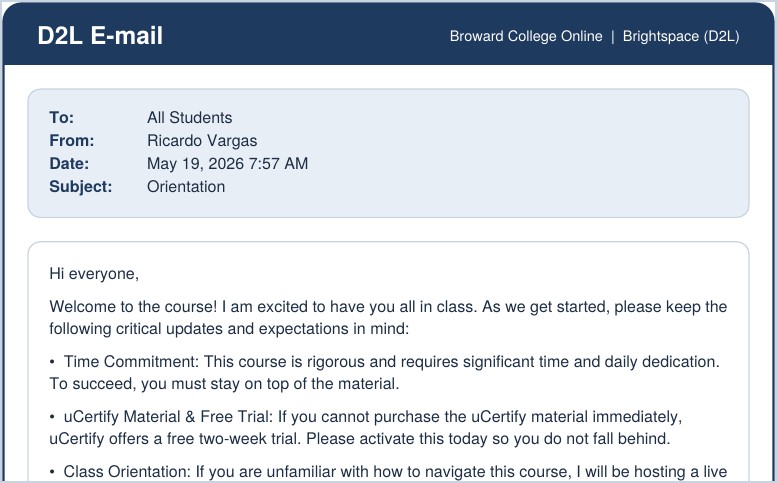
I strive to respond to all student inquiries within 12 hours, well beyond the College’s 24–36 hour standard stated in my syllabus, checking e-mail multiple times a day during the week and at least once a day on weekends. Each term begins with a live Zoom orientation that walks students through the syllabus and the D2L course shell; I record the session for students who cannot attend.
Throughout the term, students can reach me through announcements, e-mail, virtual office hours, and appointments that fit their schedules. The course café discussion forum gives them a standing place to ask questions of me and of one another.
In eleven student email threads from 2022 through 2026, every first reply but one was sent within 11 hours; the one exception, about 15 hours, spanned an overnight. When a problem is easier to solve live, I move to a Zoom call, often within minutes.
Evidence
- Course Orientation E-mail, 2022 (SSI1)
- Course Orientation E-mail, 2023 (SSI2)
- Course Orientation E-mail, 2024 (SSI3)
- Course Orientation E-mail, 2025 (SSI4)
- Course Orientation E-mail, 2026 (SSI5)
- Student Questions and Replies, 2022–2026: eleven email threads with reply times (identifying information removed) (SSI24)
Original D2L printouts: Course Orientation E-mails Source File (2022–2026); Student Questions and Replies Source File (redacted)
Engagement
Student Engagement Strategies
I connect course content to realistic workplace scenarios. In CTS 1133C, for example, students design a complete workstation for a local photography studio with a $2,000 budget and 10 TB of redundant storage, explaining how the motherboard, power supply, storage, and cooling work together. In my cybersecurity units, students analyze recent data breaches and propose solutions. Discussions use open-ended questions that ask students to apply concepts, and students must respond to classmates with substantive feedback, clarifying questions, or alternative recommendations rather than simple agreement.
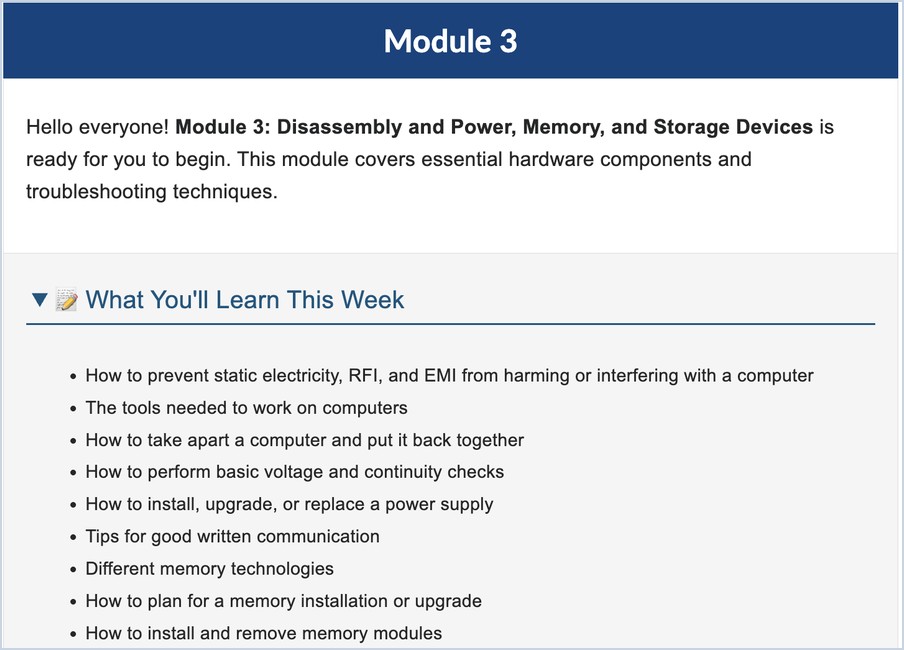
Each week, a module announcement previews what students will learn, the exam objectives covered, and what is due, so they always know where they are in the course. Hands-on virtual labs, reflection assignments, and micro-lectures I create as needed give students multiple ways to work with the material, and the course café keeps peer interaction going between assignments.
Evidence
- Discussion Prompt (Discussion 2: Small Business Build Scenario), CTS 1133C A+ Comprehensive (SSI6)
- Course Welcome Announcement, CTS 1133C A+ Comprehensive (SSI7)
- Weekly Module Announcement (Module 3), CTS 1133C A+ Comprehensive (SSI8)
- Final Week Announcement (Module 12), CTS 1133C A+ Comprehensive (SSI9)
- Letter of Recognition, Dr. Luis A. Pentzke, Principal Investigator and Grant Manager, Cybertech NSF ATE Grant (CAS9): student engagement and follow-up support in the grant’s cybersecurity boot camps
Feedback
Prompt and Constructive Feedback
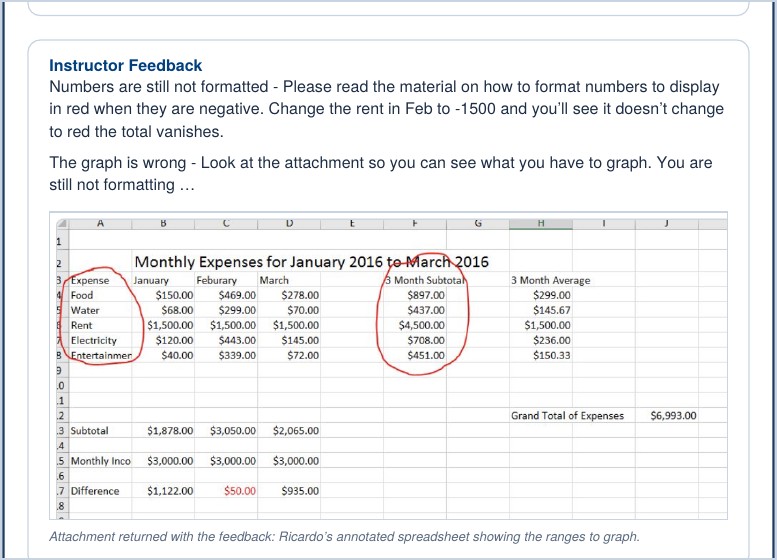
I return informal feedback on student work within 24 hours when possible and always within a week, providing specific written guidance in the D2L comments field. Students may also submit assignments early for feedback, then revise and resubmit before the due date.
Feedback combines detailed rubrics tied to learning outcomes with individual written comments, suggestions for additional resources, and recognition of strengths. Frequent graded activities, including quizzes, labs, and certification-style practice exams, let students monitor their progress throughout the term.
Evidence
Specific, actionable guidance
- Feedback Sample 1: Resume revision guidance (SSI10)
- Feedback Sample 2: Professional resume advice (SSI11)
- Feedback Sample 3: Excel charts project requirements (SSI12)
- Feedback Sample 4: Step-by-step chart correction (SSI13)
- Feedback Sample 5: Follow-up after a one-on-one Zoom call (SSI14)
Redacted original grading records: Feedback Samples Source File: Specific, Actionable Guidance
Revise and resubmit
- Feedback Sample 6: Three revisions with an annotated spreadsheet (SSI15)
- Feedback Sample 7: Correct and resubmit (SSI16)
- Feedback Sample 8: Guidance on a fifth submission (SSI17)
Redacted original grading records: Feedback Samples Source File: Revise and Resubmit
Time on Task
Adequate Time on Task
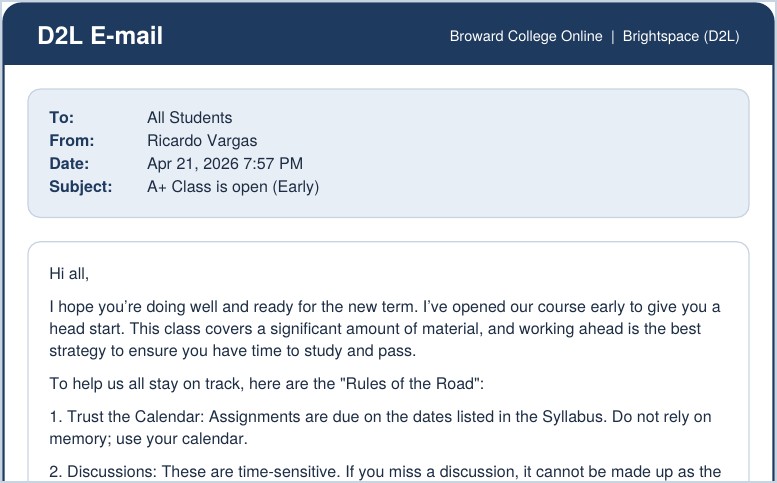
I open my courses at least two weeks before the official start date so students can get familiar with the materials, resolve technical issues, and begin working ahead. Each early-opening message encourages students to use that time well and reminds them that due dates are set in the syllabus and calendar.
Weekly modules, published due dates, and consistent module structure give students a predictable rhythm, and I regularly encourage them to work ahead so they have time to study for their certification exams.
Evidence
- Early Course Opening E-mail, 2022 (SSI18)
- Early Course Opening E-mail, 2023 (SSI19)
- Early Course Opening E-mail, 2024 (SSI20)
- Early Course Opening E-mail, 2025 (SSI21)
- Early Course Opening E-mail, 2026 (SSI22)
Original D2L printouts: Early Course Opening E-mails Source File (2022–2026)
Expectations
Setting High Expectations
My early-opening messages set clear “rules of the road” from day one: assignments are due when the syllabus says they are due, missed discussions cannot be made up, required materials must be in hand, and students are expected to read the syllabus and work ahead. The live orientation reinforces these expectations before work begins.
When students need more support, I refer them to College resources such as the library, Academic Success Centers, and tutoring, and I share campus and community resources through course announcements.
When a student shows early signs of falling behind, such as low participation, I submit an early alert through the College’s student success system so advising staff can reach out alongside me.
Evidence
- Course expectations stated in the Early Course Opening E-mails (SSI18–SSI22) and reviewed in each term’s orientation (SSI1–SSI5)
- Letter of Recommendation, Priscilla Suarez, Acting Vice Provost, Academic Services and Learning Resources (FE11): referrals to the BC Libraries, tutoring, and virtual and on-campus labs
- Referral to College support services: counseling, child care assistance, and Seahawk Outreach (identifying information removed) (SSI25)
- Early Alerts submitted for students with low participation, 2023–2026 (identifying information removed) (SSI23)
Diverse Methods
Diverse Teaching Methods
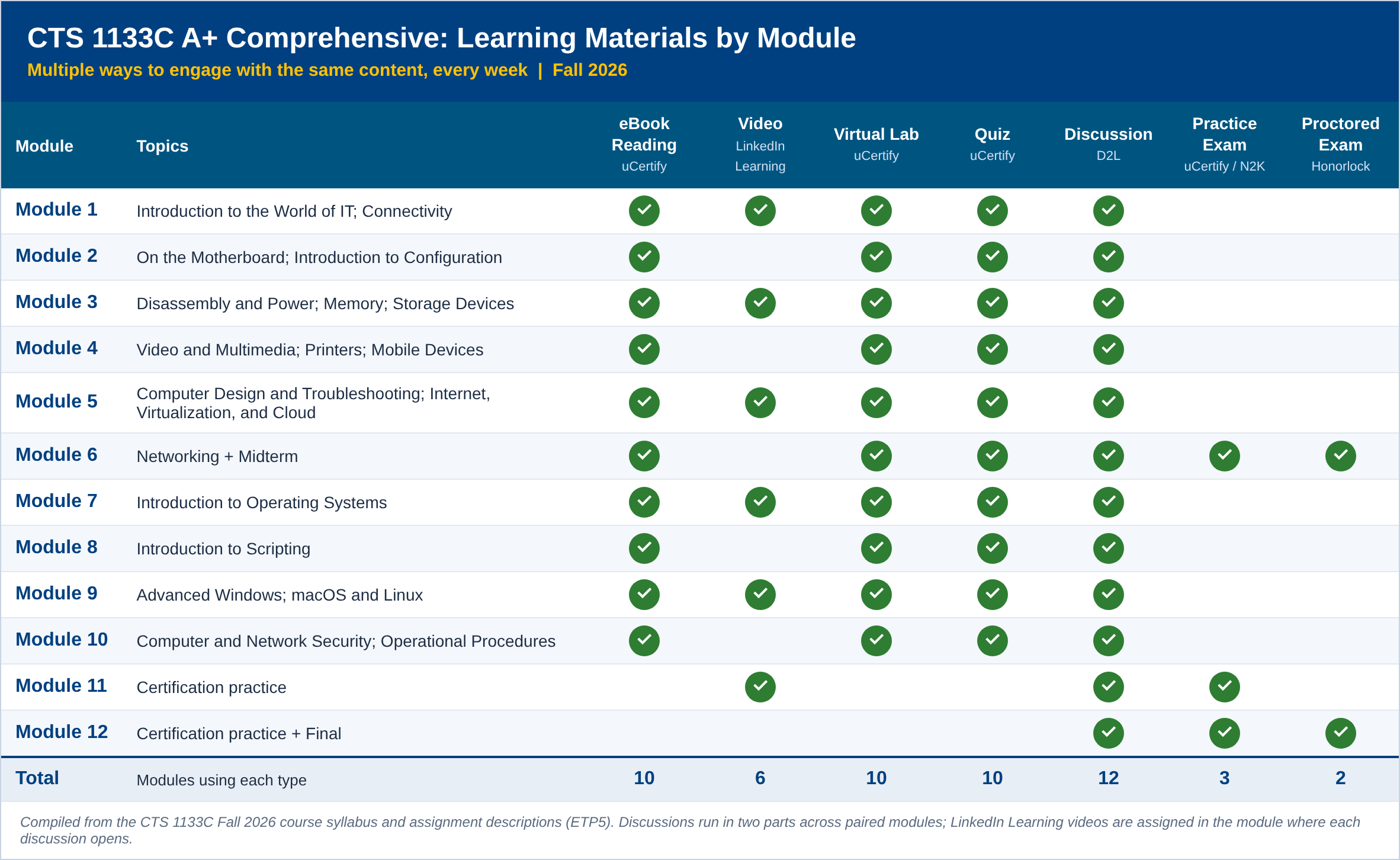
Each course pairs an e-text with instructional videos, virtual labs, and certification-style practice exams, giving students multiple ways to engage with the same content. This reflects the Universal Design for Learning principle of providing multiple means of representation.
Live orientations with recordings, discussion forums, reflection assignments, and early-submission feedback support students who arrive with different levels of preparation and confidence.
Evidence
- Learning materials by module, CTS 1133C A+ Comprehensive (ETP4): readings, videos, labs, quizzes, discussions, and practice exams across all 12 modules