
Student Course Success Data
This page presents four years of course success data (2022–2025) for the CompTIA certification courses I teach fully online, along with my participation in program assessment.
Course Success
Four Years of Results
Course success, the percentage of students who complete a course with a grade of C or better, is the College’s standard measure of student outcomes. Over the four completed academic years from 2022 through 2025, the success rate in my fully online sections of the CompTIA certification courses I teach has averaged 72.3%, two points above the 70.3% average for all sections of these courses across every campus and delivery modality.
72.3%
My fully online sections, 2022–2025 average
70.3%
All instructors, all campuses and modalities, 2022–2025 average
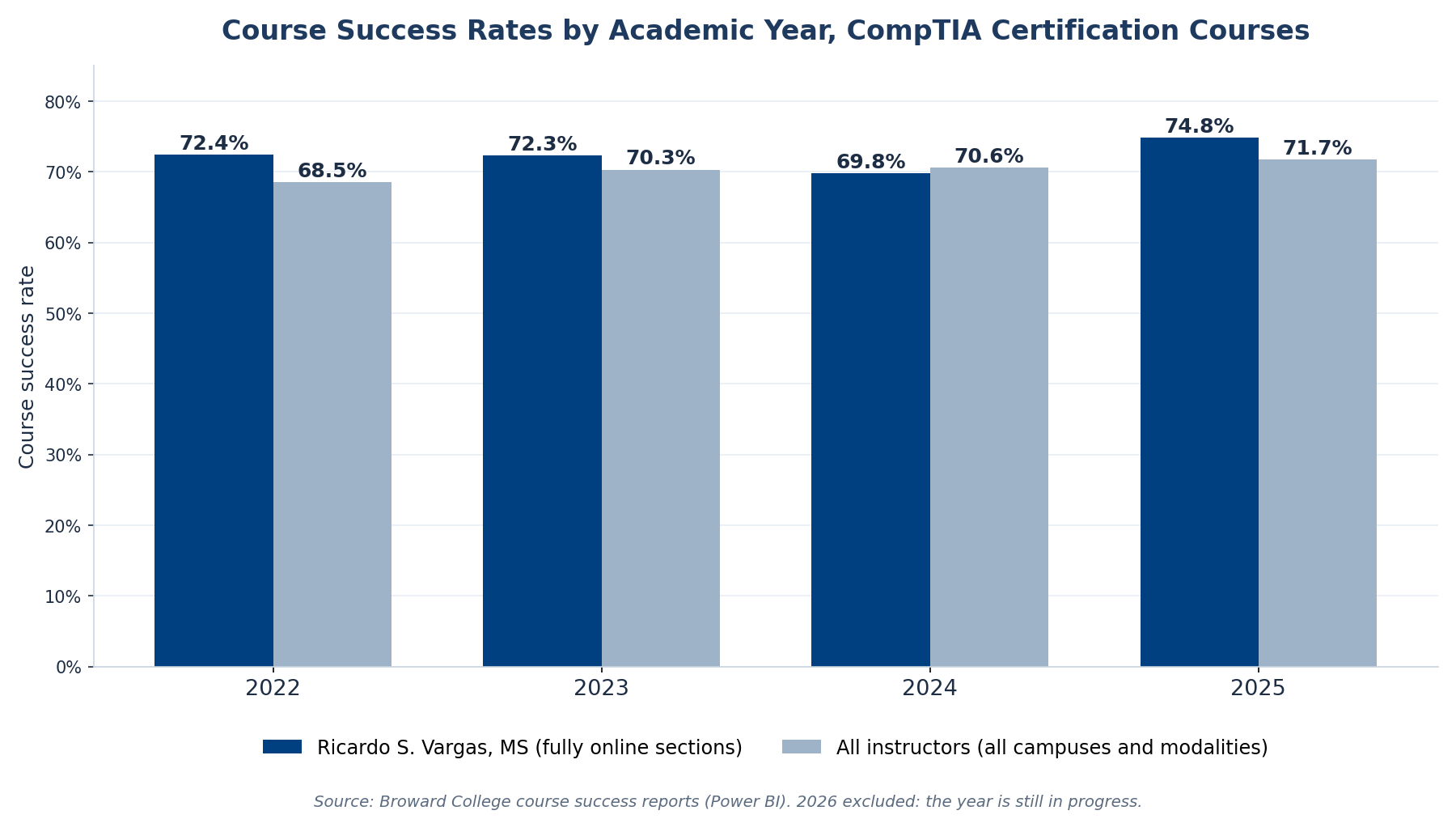
| Academic year | My fully online sections | All instructors, all campuses and modalities | Difference (points) |
|---|---|---|---|
| 2022 | 72.4% | 68.5% | +3.9 |
| 2023 | 72.3% | 70.3% | +2.0 |
| 2024 | 69.8% | 70.6% | −0.8 |
| 2025 | 74.8% | 71.7% | +3.1 |
| Four-year average* | 72.3% | 70.3% | +2.0 |
The Source Reports
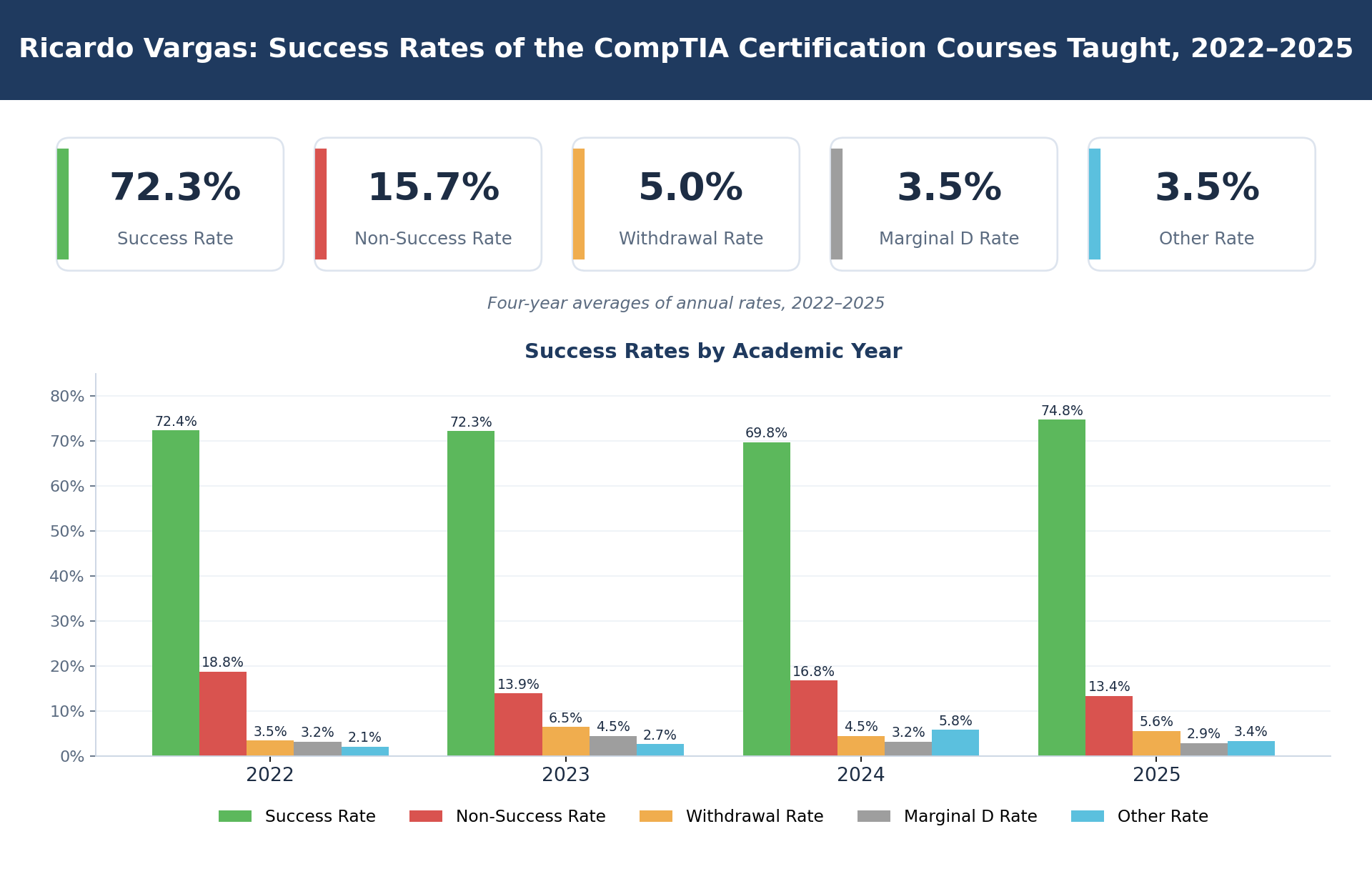
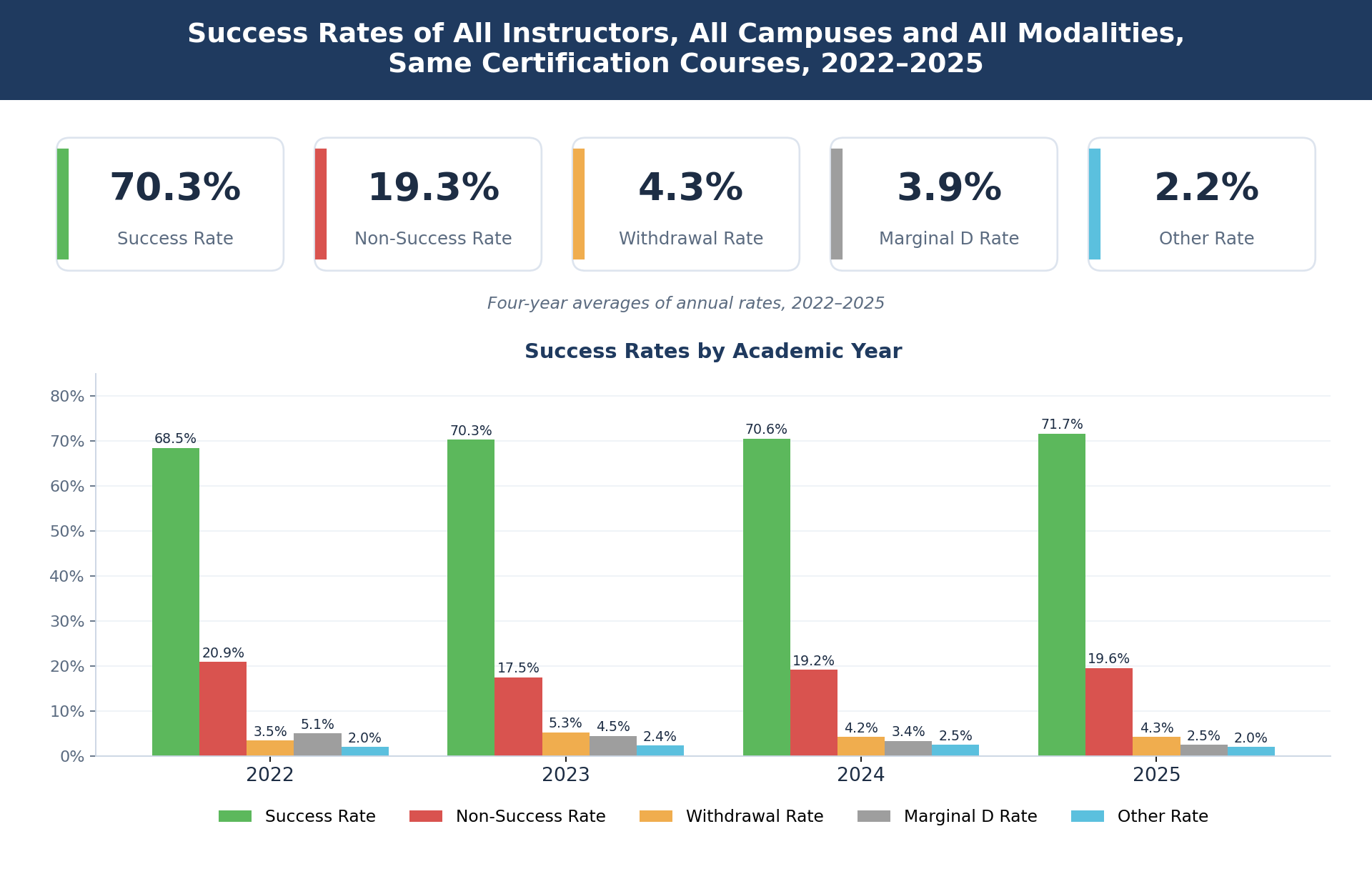
Click either image to view it full size.
Context
Understanding the Comparison
The comparison above sets my fully online sections against all sections of the same courses, including face-to-face and blended sections. That is a demanding benchmark. Research on community college students has long found that success rates in online courses trail face-to-face rates. A 2013 research summary from the Community College Research Center at Columbia University reported an eight-percentage-point gap in course completion between online and face-to-face courses, and California Community Colleges Chancellor’s Office data for Spring 2016 showed a statewide online success rate of 63.7%, compared with 71.8% for face-to-face courses.
My online sections have exceeded the all-modality average in three of the four completed years, and the college-wide figures include my own sections. I also teach most of the online sections of these courses: in some terms all of them, and typically four to five sections each term compared with one or two taught by other instructors. As a result, the online outcomes for these courses largely reflect my teaching, across a far larger and more varied group of students than any other online instructor serves. For that reason, this page does not compare my sections with all online sections of these courses: because my sections make up most or all of that group each term, the comparison would largely measure my results against themselves, and the few remaining sections taught by others are too small a group to serve as a meaningful benchmark.
My online sections exceeded the all-modality average in three of the four completed years, even though community college research consistently finds that success rates in online courses trail face-to-face rates.
Ricardo S. Vargas, MS
Reflection
Using the Data to Improve
I review these results each term alongside my own course data. The 2026 figures are still in progress, covering only the Spring and Summer terms, so they are not yet comparable to complete years; I will review the full-year results once Fall grades are final and identify where students struggled.
The practices documented on my Student Success Indicators page are my primary response to this data: opening courses early to give students more time on task, holding orientations each term, returning prompt and specific feedback, and allowing students to revise and resubmit their work. Keeping each course aligned with the current CompTIA exam objectives, documented on my Effective Teaching Practices page, ensures students are preparing for the certification exams they will actually take.
Program Assessment
Participation in Assessment
I regularly participate in my program’s annual assessment of student learning outcomes. Each assessment cycle, I provide final exam results from my courses to the program manager for the Computer Information Technology A.S. program, where they are used to measure student learning outcomes in the program’s Institutional Effectiveness plan, as documented in the following correspondence: