
Faculty Evaluation
Faculty Evaluation and Performance Documentation
A documented record of my performance as online faculty, drawing on summative evaluations, course observations, self-assessment, letters of recommendation, and teaching load.
Overview
A Documented Record of Performance
This page documents my performance as online faculty against the College’s faculty responsibilities and evaluation standards. It brings together the formal evaluation record (annual summative evaluations and online course observations) with my own reflective self-assessments, letters of recommendation from academic leaders and colleagues, and documentation of my teaching load.
Taken together, these materials speak to both the quality and the scope of my work: the evaluations and observations document effective online teaching; the self-assessments show sustained reflection and growth; the letters of recommendation provide the perspective of the deans, associate dean, and grant leadership who have supervised or directly observed my work; and the load documentation records teaching that has consistently met and exceeded contractual expectations.
Consistent evaluations, continued reflection, and a sustained teaching load together document a reliable record of effective online instruction.
Ricardo S. Vargas, MS
Evaluation Record
Annual Summative Evaluations
Strong
Every evaluated category, 2023 and 2024
Exceeds Expectations
Every evaluated category, 2025
Across the review period, my annual summative evaluations, conducted by my Associate Dean of IT and Engineering, document consistently high performance and a clear upward trajectory. In both 2023 and 2024, I received a rating of Strong in every evaluated category: the four areas of Teaching (Content Knowledge, Instructional Delivery, Instructional Management, and Service to Students), Service to the College, and Professional Development. In 2025, every category advanced to the highest rating, Exceeds Expectations, with no performance improvement plan required.
The evaluations speak directly to my teaching in the fully online environment. My evaluator noted that I am “highly knowledgeable and skilled in all areas” I teach, that I stay current with changes in my content areas, and that I deliver instruction that is “both rigorous and industry-relevant.” My asynchronous online courses were recognized for weekly announcements, closely monitored communication to ensure timely responses, well-organized D2L course design, daily course management, and current grading, with courses frequently prepared and opened early so students can begin work ahead of schedule. In service to students, the evaluations highlight my support beyond the classroom through certification preparation, academic and career guidance, and connecting students to resources.
My service to the College is likewise documented as sustained and growing: participation in Pathway and departmental shared governance, grade appeal and Professor of the Year selection committees, and the college-wide Digital Divide committee in the earlier years, expanding by 2025 to the Environmental Sustainability Committee, including service as chair of its New Initiatives Subcommittee. Professional development was rated favorably throughout, with my evaluator noting that I consistently exceed the required professional development hours.
Taken together, my three years of evaluations, which moved from uniformly Strong to uniformly Exceeds Expectations, provide an independent, supervisor-verified record of effective online teaching, meaningful service, and sustained professional growth. The individual evaluations are linked below.
| Evaluation category | 2023 | 2024 | 2025 |
|---|---|---|---|
| Teaching: Content Knowledge | Strong | Strong | Exceeds Expectations |
| Teaching: Instructional Delivery | Strong | Strong | Exceeds Expectations |
| Teaching: Instructional Management | Strong | Strong | Exceeds Expectations |
| Teaching: Service to Students | Strong | Strong | Exceeds Expectations |
| Service to the College | Strong | Strong | Exceeds Expectations |
| Professional Development | Strong | Strong | Exceeds Expectations |
- 2023 Yearly Summative Evaluation (FE1)
- 2024 Yearly Summative Evaluation (FE2)
- 2025 Yearly Summative Evaluation (FE3)
Observed Teaching
Online Course Observations
In addition to annual summative evaluations, my Associate Dean has conducted formal observations of my asynchronous online courses across the review period, assessing my teaching in the actual learning environment. The observations span multiple courses, including CGS 1060C and CTS 2120C, and evaluate course design, instructional delivery, faculty presence, and rapport with students.
The results are consistently exemplary. Across the detailed online-course observation criteria, I received a rating of Exceeds Expectations on every item: regular and substantive weekly announcements; a well-organized, easy-to-navigate syllabus with clear expectations, office hours, schedule, and grading information; well-designed and consistent course navigation; modules that clearly specify learning outcomes, content, activities, and assessments; materials appropriate to the online modality and aligned to outcomes at an appropriate level of rigor; effective use of course tools and learning activities to facilitate engagement; timely assessment and constructive feedback; and prompt, professional communication that maintains a positive and respectful online environment.
The observers’ narrative comments reinforce these ratings. My courses were described as having a “well organized D2L classroom/workspace” with materials arranged “in a logical order for maximum potential for learning,” and my communication was noted for close email monitoring and responses to students “within 24 hours whenever possible.” The summary comments characterize me as an “exemplary member of our Faculty,” an “exemplary instructor,” and “a valuable instructor to the IT and Engineering Pathway.”
Together, these observations provide direct, environment-specific evidence that my asynchronous online teaching consistently meets the highest standard of the College’s evaluation criteria, from the design of the course shell through the ongoing facilitation of student learning. The individual observations are linked below.
- 2023 Classroom Observation (FE4)
- 2024 Classroom Observation (FE5)
- 2025 Classroom Observation (FE6)
Reflection
Self-Assessment
Each year I complete a reflective self-assessment examining my teaching, identifying strengths, and setting priorities for continued growth in online course delivery and student support.
- 2023 Self-Assessment (FE7)
- 2024 Self-Assessment (FE8)
- 2025 Self-Assessment (FE9)
- 2026 Self-Assessment (FE10)
Support
Letters of Recommendation
These letters from academic leaders and colleagues who have supervised or directly observed my work speak to my teaching, service, and contributions to the Online Campus and the College.
- Priscilla Suarez — Acting Vice Provost, Academic Services and Learning Resources (former Dean, Online Campus) (FE11)
“He is a student-centered educator, committed to nurturing students’ love and understanding of technology and preparing them for the future of work.” - Rudy Jean-Bart — Acting Dean, Online Campus and E-Learning (FE12)
“Having participated in over 20 grade appeal hearings with Professor Vargas, I can attest that he is a key member of our committee.” - Mitch McBee — Associate Dean, IT and Engineering (FE13)
“I support his application for continuing contract without reservation. He will continue to be a cornerstone of our faculty for years to come.” - Dr. Luis A. Pentzke — Principal Investigator and Grant Manager, Cybertech NSF ATE Grant (CAS9)
“Your technical expertise, pedagogical skill, and dedication to student success make you an invaluable asset to Broward College and the broader cybersecurity education community.”
Teaching Load
Meeting and Exceeding Faculty Load
A full-time faculty member’s normal teaching load is thirty credit hours per academic year, with teaching beyond that compensated as overload. Across the review period I have consistently taught well beyond the normal load while sustaining large online enrollments and full student support across fall, spring, and summer terms.
Each year of the review period, my teaching has roughly doubled the normal annual load:
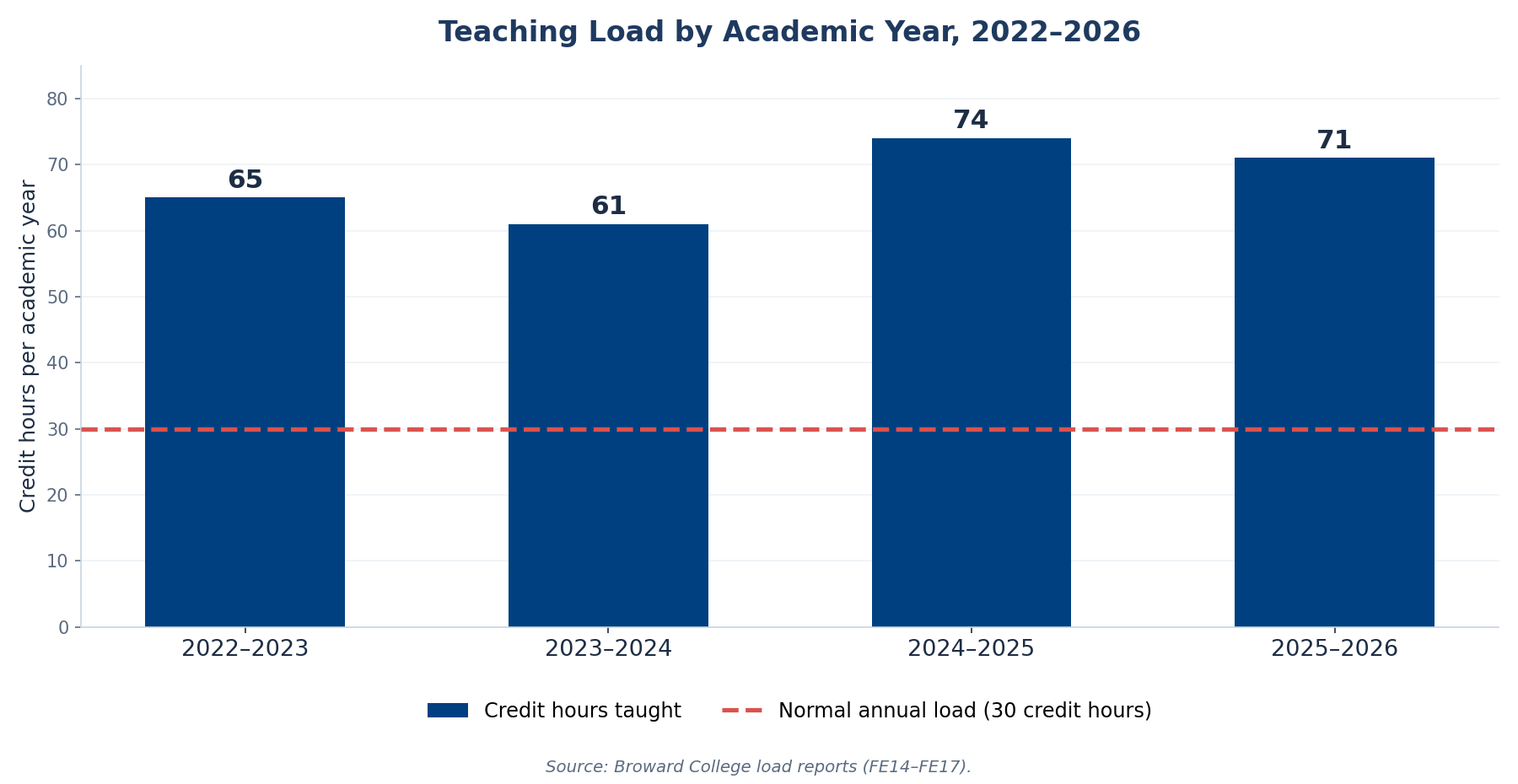
- 2022–2023 17 sections · 65 credit hours · 553 student enrollments — Load Report (FE14)
- 2023–2024 16 sections · 61 credit hours · 538 student enrollments — Load Report (FE15)
- 2024–2025 19 sections · 74 credit hours · 625 student enrollments — Load Report (FE16)
- 2025–2026 18 sections · 71 credit hours · 618 student enrollments — Load Report (FE17)
Each section is a fully online course requiring continuous instructor presence of at least twenty-five hours per week of combined course contact and student availability through the College’s learning management system. Teaching at roughly twice the normal load, across multiple concurrent sections and three terms a year, means sustaining that presence of timely feedback, announcements, discussion facilitation, and individual student support consistently, term after term.
Student Voice
Student Feedback
The Online Campus has not administered Student Opinion of Instruction surveys during my review period, so formal survey data is not available for my sections. The College is re-implementing these surveys for online courses beginning this semester.
In the meantime, students’ experience of my teaching is reflected in two other sources: my associate dean’s online course observations, which rated communication and rapport with students Exceeds Expectations every year (FE4–FE6), and the students’ own comments in my feedback samples on the Student Success Indicators page, where students ask for guidance, revise their work, and respond to my feedback.